

I remember the moment in 11th grade. My friend and I climbing out of the subway station on the Upper West Side near our school, discussing, as we so often did, the state of the world and our place in it, and her turning to me and asking: why do so many adults abandon their politics and become cogs in the machine? Is it that they know more than us, or that they have it beaten out of them?
I don’t know why, I told her. But I said I wasn’t worried. We were different. That would never happen to us.
At that point, both of us were as far left as two teens could be—anarcho-communists and anti-imperialists. We’d attend any and every protest for a leftist cause. My friend organized a school club inspired by Columbia’s SDS. That school year, I traveled with dozens of my classmates to Venezuela to tour the Bolivarian socialist revolution and take notes on how we could possibly foment something similar back home.
It was only a matter of time, I thought, before the United States turned into a socialist paradise. All we had to do was usher it along. And I was ready to do the ushering.
And then…things changed. Not my politics, really—I’m still an anti-capitalist and anti-imperialist. It’s more that, a few years ago, I realized my sense of possibility had dramatically decreased.
My Overton window hadn’t shifted; it’d developed a layer of grime that made possible futures seem hazier and less bright.
You cannot fight for what you cannot envision.
In short: I had become my (and my friend’s) worst fear: a cog.
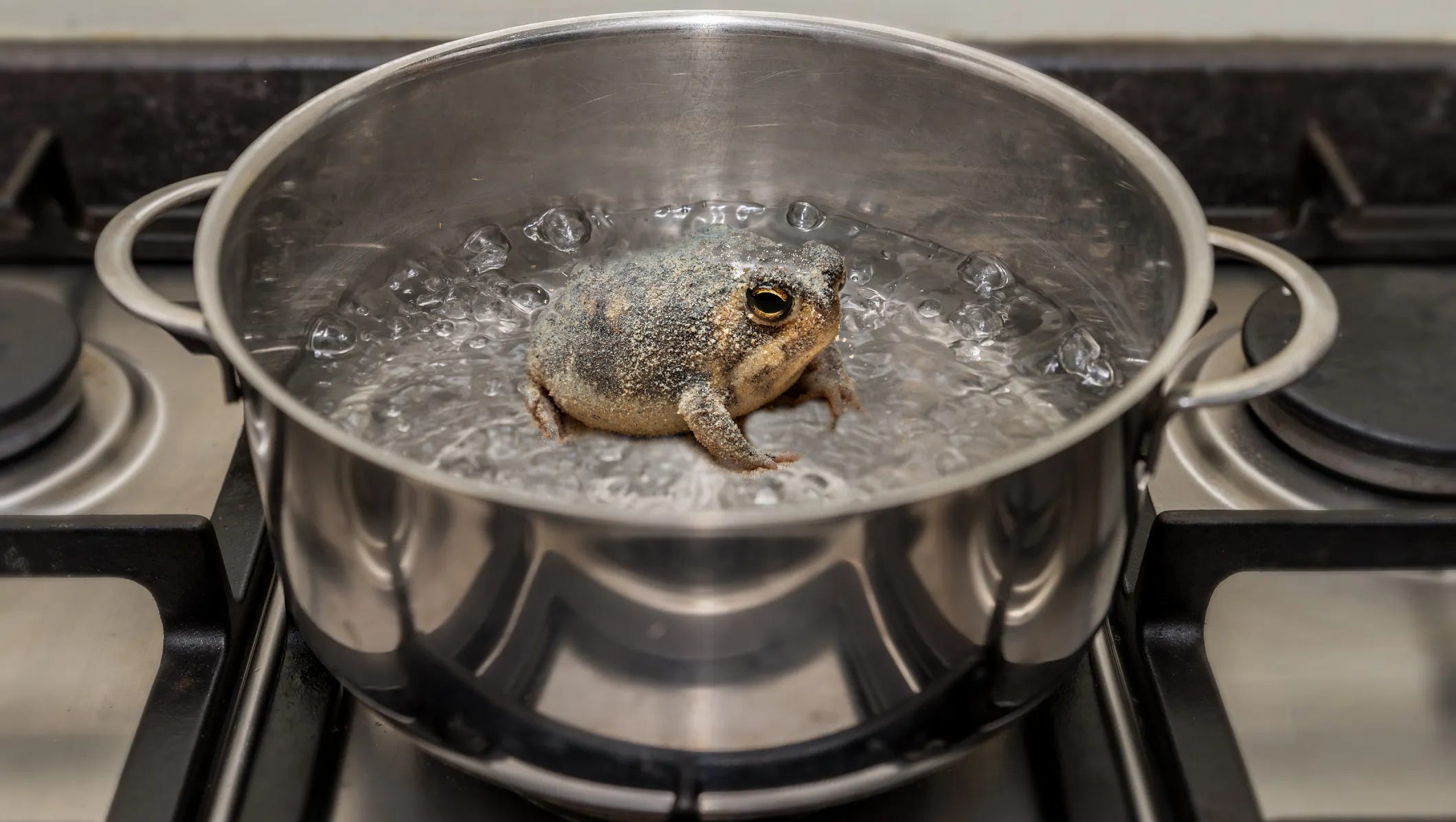
Or maybe a frog.
Looking back at the last two decades of my life since that conversation in high school, I can see what happened to me. And my friend and I were both wrong—it’s not that adults have their idealism beaten out of them. And it’s not that we simply know more—that we are mature enough to be realists instead of idealists. It’s that the longer you exist in this world, the longer you spend in its psychosociopolitical milieu, and thus become increasingly infused with whatever is around you.
It’s easier to be a radical when you’re young not because you’re naive, but because you haven’t yet absorbed the messaging of the world that tells you good things are often impossible. And, crucially, all the people around you—your young peers—haven’t yet either.
When I was a teen at a semi-socialist educational institution, I existed within a positive feedback loop, my peers steeping me in their hopes and beliefs so that my hopes and beliefs did not feel unrealistic. You are what you read, you are what you eat, and, also, maybe, you are who you see.
But then, as you age, the people you see change. You get a job and your thoughts of revolution aren’t so much beat out of you as they are supplanted. You think of money and building a life and all the rest, and everyone else around you does too. As your milieu changes, so do you. And any kind of fantastical future gets hazier and hazier.
How, then, to recommit?
The first step, I believe, is to realize that you do indeed exist in a milieu in the first place; to not take for granted that you are influenced by what you consume and who you talk to and what you spend your time doing.
You do not need to attend a leftist public school to believe in a better future. But you do need to become aware of the water in which you sit. Perhaps for years you have marinated there, not realizing how far from what you once believed you’ve strayed. Perhaps you’ve normalized the lack of hope, or aggrievedness inside of you, because everything else around you feels the same. Perhaps the water has gotten slightly warmer over the years without you noticing. Perhaps now is the perfect opportunity to jump out.