

We so take for granted the idea that emotional connection is necessary for human existence that we don’t even notice how much of our lives revolve around attempting to optimize it. We go to therapy to work on our relational issues. We browse Instagram and TikTok for the countless videos of pop psychologists problematizing and then proposing solutions to your “attachment style” (are you avoidant, or insecure, or dismissive-avoidant, or disorganized, or secure (is anyone??). You know you keep going back to that man who is mean to you, even though you know he’s mean to you, because so deep is the need for the warm embrace of another human.
But for many decades, psychologists and Western culture writ large operated on the assumption that emotional connection and comfort were, at best, secondary to other basic needs, and, at worst, harmful to the human psyche.
In the 1940s and 50s, the prevailing wisdom on raising children was that showing them love was counterproductive and dangerous. John B. Watson, the head of the American Psychological Association beginning in 1915, advised parents to barely have any physical contact with their children and to keep an emotional distance from them, lest they become spoiled. “When you are tempted to pet your child, remember that mother love is a dangerous instrument,” he once said.
Enter Harry Harlow, a psychologist and researcher at the University of Wisconsin-Madison, who, in the late 1950s, decided to disprove his field’s theories in the most fucked up way imaginable.
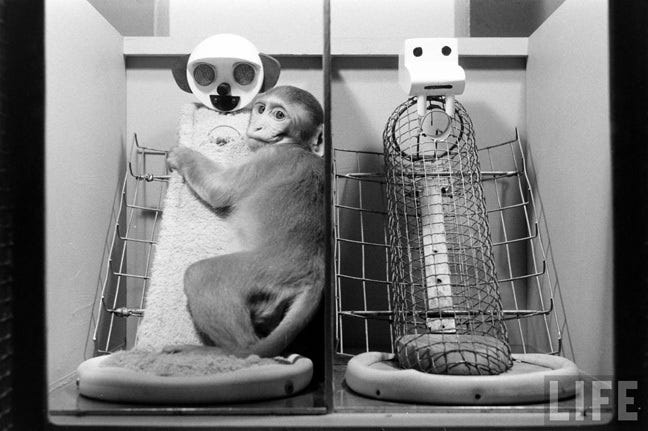
From his lab on campus, which was known as Goon Park (seriously), Harlow and his students began separating baby rhesus monkeys from their mothers just a few hours after their birth. After a period of isolation in what Harlow called the “pit of despair,” he’d then introduce the monkeys to various “surrogate mothers” made of wood and wire to see which the babies preferred. Some of the wire mothers were covered in soft materials like terrycloth and some were left bare. The experiments were sometimes almost comically evil—one surrogate mother had its head attached backwards in an attempt to scare the babies, another shot compressed air at the babies, and one wire mother, which Harlow called “the Iron Maiden” had brass spikes that popped out intermittently to jab the baby monkeys.
The experiments proved what Harlow wanted them to: that connection and comfort can be as important as any other basic need.
The baby rhesus monkeys spent much more time clinging to the soft mothers than they did the wire ones, even if the wire ones gave the babies food and the terrycloth ones did not. When exposed to frightening situations in the lab, the monkeys would cling harder to the soft surrogates. And without their presence, the babies would refuse to explore their environments at all. They’d sit still, sucking their thumbs, paralyzed in fear. Even if the cloth mothers hurt the monkeys, they’d still cling on. Connection, even connection that came with pain, was worth it.
***
It was not until the 1960s that the world began to treat tobacco use as a major health epidemic; it was not until the 1990s that the World Health Organization first recognized that the word’s lack of access to fresh and nutritious food was causing myriad health problems. It will likely take another few decades for us to fully come to terms with our crisis of disconnection.
And so, in the interim, we are left to fend for ourselves; left to find substitutes for what we actually need, even if those substitutes are often harmful to our wellbeing. The systemic problem—that the world has become ever-more isolating and alienating—has been met with individualist solutions.
Over the past year or so, I’ve watched as the world has gawked at stories of people falling in love with AI chatbots, or committing suicide when they’re told to do so by those bots. These stories are often framed as extreme cases of extremely lonely people being wooed by a seductive new technology built with insufficient safeguards.
But I think by understanding these stories as exceptional, we’ve let ourselves off the hook. AI psychosis is just the furthest node on a spectrum of an entire world’s attempt to replace a withheld real connection with surrogate support.