

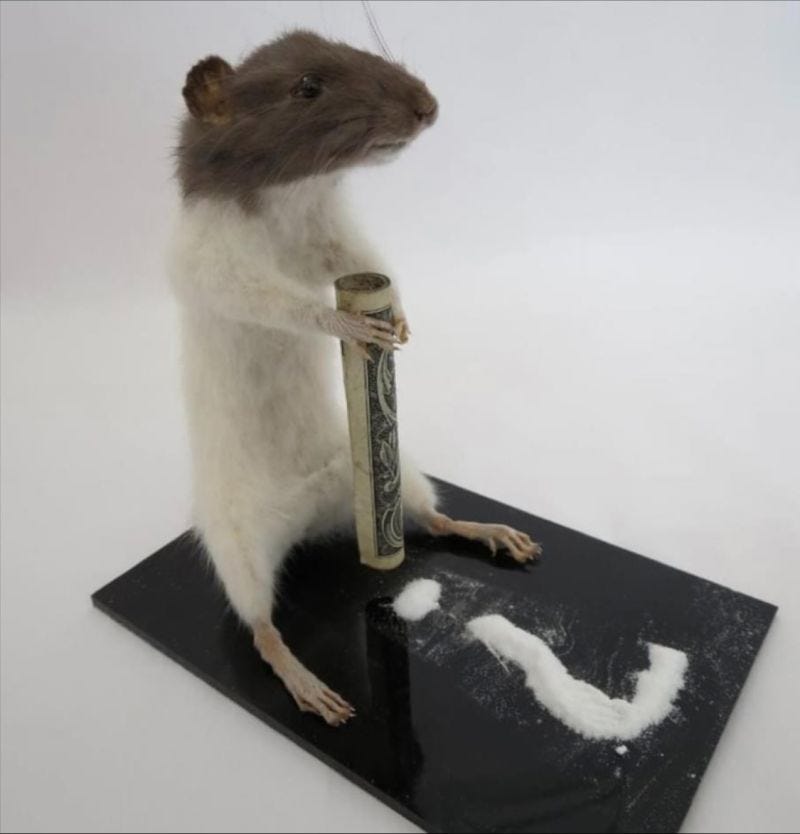
[The title of this piece is a reference to the Smashing Pumpkins, in case you didn’t get it].
What Would You Do Alone in a Cage with Nothing but Cocaine? is the title of philosopher and bioethicist Hanna Pickard’s recently-published book, and also a question I can’t stop thinking about (I would probably do a lot of cocaine).
The title comes from experiments scientists ran in the 1980s in which they placed rats in cages with a lever that would immediately inject them with rat-sized portions of cocaine. And they found that the rats would start going for the cocaine lever more than the levers for food or water, over and over again, to the point of exhaustion, starvation and death.
The studies became part of the basis for our current understanding of addiction as a kind of disease of irrationality—the drugs take you over, and you start acting against your own best interests because of your biochemical predisposition to their power, and the chemical dependency they cause.
But Pickard’s book poses a very interesting question: what if addiction is less about the cocaine, and more about the the cage? Because, she posits (to vastly oversimplify the argument of her very good and thorough book): all of us would probably start doing a lot of cocaine if we were left trapped, unsocialized, and unstimulated.
And that’s what Pickard’s book is about: what if we all (to greater and lesser extents) are stuck in some sort of cage of mental anguish caused by our surroundings? What if some drug users, like the rats, are under-stimulated and under-socialized and generally not having their other needs met?
Pickard argues that we need to change how we think about drug addiction to consider not just the individual or the drug, but their surrounding environments and circumstances. Only then—when everyone is out of the cage—will we be able to solve the problem of destructive drug use.
Pickard was nice enough to talk to me about addiction, rats and (to paraphrase Marianne Williamson) how to completely change everything about human civilization.
I highly recommend checking out her book.
This interview has been edited and condensed.
I wanted to start with the first paragraph of your book, which poses the question of the title: What do you think rats would do alone in a cage with nothing but cocaine? And you basically say, it’s probably not very surprising that the rats ended up doing a lot of cocaine! I loved starting here because it kind of makes obvious what, in my opinion, should already be obvious: that addiction and drug use is contextual. It’s not just about chemicals, it’s about external factors. If any of us were left alone in a cage with nothing but cocaine, we’d probably become addicted to cocaine. Can you talk a little about that—the context of addiction?
I think we have a false narrative, or false ideology, around our thinking about addiction, and I think pretty much everyone would know that if they just stopped and thought about it for a second. But we’re kind of stuck in it, so the really interesting question to me is why are we stuck in it.
The science of animal models can be such a powerful antidote to our false narratives and ideology. The rats are an image that people interpret as meaning the disease model of addiction is true—that addiction is really and fully explained by the power of drugs to compel use alone. But somehow, we don’t see in that image something else: that the rats are alone in a cage with nothing but cocaine. And if you do the imagined work of putting yourself in that context, I think most of us, if we were honest, would say, “Well I would take a lot of cocaine, not because my brain was hijacked by drugs, but because of the suffering and misery inherent in that experience of living permanently in isolation.”
I think the study is kind of a lovely hook because on the one hand it helps us see the power the story of the disease model has over us, but also actually undermines it—it makes us think wait hang on, what about the experiment itself, what about the circumstances.
Two decades later, Serge H. Ahmed, who I’ve collaborated with, did this brilliant work where he simply engineered an experimental chamber to give rats a choice. And what he found is that even when they showed every indication of addiction, when they were given the choice between a drug and an alternative reward—he started with saccharine water—they took it. And so that really vindicated this idea that it wasn’t just the cocaine, it was being alone in a cage with nothing but cocaine.
Right, as you say in the book: the rats were taking the best of a bad set of options. Which is a very concise way to frame their behavior, and probably all of our behavior too.
I think we have this false idea that when people do things that are really bad for them, it’s always expressive of a kind of irrationality or pathology in them, and sometimes that’s just false. We can all be in positions where we’re stuck between a rock and a hard place. And I really think many cases of addiction ought to be seen that way. It’s not necessarily pathological or irrational. The problem really has to do with the the alternatives available to a person, as opposed to something intrinsically being wrong with them.
One of the other rat studies you cite shows that when you give rats an alternative, like hanging out with other rats, it seems to prevent them from becoming addicted to cocaine.