

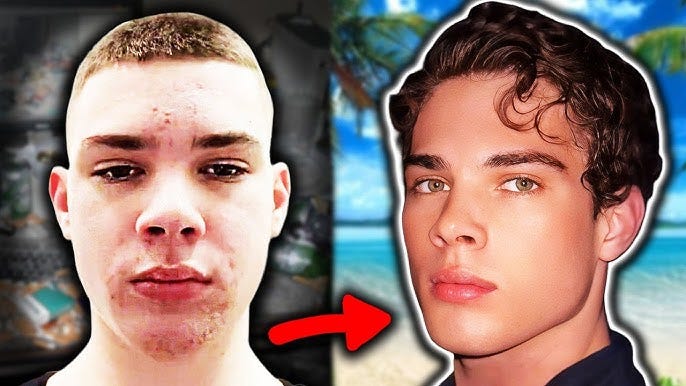
I have had several surgeries on my face—I had my jawbone and forehead shaved and had my nose broken and reformed into a different nose, and had my eyelids turned into a slightly different shape and had some botox put in right above my lip to “flip” it. Most of this, blissfully, was covered by medicaid several years ago, as all “gender affirming” surgeries are required to be if you have publicly-funded insurance in New York State.
My face might be worth $100,000. I don’t know. I never got a bill.
For 7 years I’ve injected hormones into my butt cheek. I’ve injected other medications that modify these hormones as well.
I go to the gym to become more toned.
Much of my life has been dedicated to changing my appearance.
Which is to say: looksmaxxers have nothing on me.
For years, I’ve struggled to parse why I should feel good about all this, and feel morally repulsed by other forms of body modification. Why am I encouraged by my lefty and liberal peers to do whatever the fuck I want to my body because it will make me more me, make me feel happier, make me into a more stable person capable of love, while cis women getting botox is seen by those same people as a form of conformity to sexist beauty standards, and while the women in Trump’s circle getting god-knows-what surgeries are considered ghoulish fascists for their aesthetic decisions (in addition to all their other evil decisions), and while straight men who take peptides and steroids and exercise and, increasingly, get surgeries too, are considered incel freaks for messing with their own bodies?
How are any of these things different?
Over the last few months, the internet-based, incel-born subculture of “looksmaxxing” has gone mainstream. One of its most prominent proponents, the 20-year old streamer Braden Peters, who goes by the moniker Clavicular, has been in the pages of GQ, The Guardian, Rolling Stone, and the New York Times (the GQ profile is the best one, BTW). The profiles of Peters range from quizzical looks at his day-to-day life (he walked the runway of a Dimes Square darling’s fashion show; he got into a fight in a club, he streamed and made content, he ate fast food), to dire warnings that he represents a fast-encroaching misogynistic fascism infecting America’s young men.
The fascination with Clavicular was at first puzzling to me, because the main thing you learn from all those profiles is that he is boring and stupid. He doesn’t know who Zohran Mamdani is. He doesn’t know what Seinfeld is. He hasn’t read a book in years, if ever. He can’t really articulate his views on the world or himself at all—it’s not that he has no coherent politics, it’s that he has no coherent thoughts.
But, I guess, it makes sense. He’s popular for two reasons:
The first is that Clavicular’s real skill isn’t body modification, it’s in milking the internet for clicks and money—figuring out the exact right formula of controversial-sounding soundbites and stunts to make himself exit the orbit of inceldom and enter the orbit of the mainstream media, which then funnels more people back to his orbit, where he makes millions of dollars from streaming and selling “courses” to lonely men on how to look better and successfully talk to women for $49 a month.
The second is that the mainstream world isn’t yet accustomed to the idea of extensive body modification. It’s novel to them. For trans and queer people, what Clavicular and his ilk do is—while different in the specifics of the substances and surgeries—very similar to what we’ve been doing for eons. Trans people become trans largely through modifying their bodies—taking medications often developed for purposes other than transition, and figuring out how to use them to become the people they want to be. Even garden-variety gay people are often experts on body modification. Ask the gay guys around you how much they go to the gym, what supplement stack they’re on, what steroids and/or hormones and/or peptides they take to bulk up or slim down.
So how do we square these two things if they’re so similar? How can some people support trans and queer body modification, while looking askance at cis men dabbling in hormones and surgeries and all the rest?
Well, the answer is that we’re looking at the wrong thing.
Body modification is a practice that is common throughout many cultures, but it is not the culture itself. Modifying one’s anatomy is what the external world sees of a much larger set of goals and communal beliefs.
And it is in those beliefs and goals where Clavicular and the looksmaxxers deviate from trans and queer people. Because one culture is, or at least can be, or at least has been in the past, liberatory, and the other helps to concretize and exacerbate already-existing power structures.
Looksmaxxers aren’t right-wing because they looksmaxx, they’re right-wing because their primary concern is gaining power and money by selling false solutions to vulnerable people looking for connection and reprieve from the dispiriting and isolating nature of capitalism.
These looks-based features of right-wing culture are getting attention because they feel new, but they follow the same trajectory of what the entire right-wing playbook has become: identify a feeling of powerlessness amongst vulnerable people, identify a cause of this powerlessness, and then sell individualist snake oil cures until the problem and solution become an ouroboros, exacerbating whatever issue the cure was meant to solve, and thus creating new customers for said cure.