

This is part one of a series on fostering your own agency. This one is free. The next ones won’t be.

One of my favorite scenes in The Sopranos is in season three, when Carmela goes to a therapist for the first time. She’s attempting to figure out how to live with her husband’s misdeeds constantly on her mind; how to process the guilt and shame of her complicity, how to endure Tony’s constant violence, both towards other people and herself.
Carmela is, of course, a victim—the emotionally abused wife of a violent criminal. But she also over and over again convinces herself to stay with Tony, largely by convincing herself that it either would be morally wrong to leave (she’s a Catholic), or that it would simply be too hard to live a life independently.
In the scene, Carmela expects her old, Jewish, bespectacled therapist to empathize with her predicament. Instead, he tells her to take her kids and leave Tony. Carmela is shocked.
“I thought psychiatrists weren’t supposed to be judgmental,” she says.
“Many patients want to be excused for their current predicament because of events that occurred in their childhood,” the therapist says. “That’s what psychiatry has become in America. Visit any shopping mall or ethnic pride parade to witness the results.”
He continues: You’ll never be able to feel good about yourself, you’ll never not feel guilt and shame, if you’re Tony’s accomplice. Carmela tells him he’s wrong about her being an accomplice. He replies that maybe he should call her an enabler instead, then.
Carmela takes a moment to process this.
“So…you think I need to define my boundaries more clearly,” she finally replies. “Keep a certain distance. Not internalize —”
The therapist interrupts and hammers home his point. Leave! But it’s too late. “Boundaries.” “Not internalizing.” Carmela has used the language of therapy not to take accountability and change her life, but to keep it exactly the same.
The session ends. She stays with Tony for several more years.
It is very hard to be told that you have agency, and that you can use it. It is even harder to be told that you have agency and that you’ve used that agency to harm other people, or harm yourself, or create a clusterfuck within your relationships or community or career. And it’s perhaps ever-harder to do that these days, when so much of therapy, especially its most popular online iterations, is intent on telling you that you are always the victim and never the perpetrator.
Of course, this self-disempowerment makes economic sense, especially online. If advice is doled out not by what is best, but what has the highest probability of being shared and racking up views, then it stands to reason that videos that tell people their struggles are because of their innate neurodivergence, or because they grew up as the child of narcissistic parents, or because they’ve entered into a relationship with the wrong kind of attachment dynamic, are more popular than ones that tell you you might have been a dick, or that you’re the narcissistic partner or parent; more popular than ones that tell you that even if, yes, you grew up in unfavorable conditions which wrecked your attachment style or ability to consistently be there for others or yourself, that doesn’t mean you’re off the hook for perpetuating these same conditions for yourself and others; that it is more likely you will perpetuate those things if you are incapable of admitting they exist within you; that of course you are capable of those things because we all mimic and extend what was done to us; that you can be both victim and perpetrator; that, indeed, being a victim is often what leads you to being a perpetrator. We all are both.
I’ve never seen a Reel or TikTok that tells you that. Its emotional shape is incompatible with the ecosystem of the internet; a decagonal, spiky peg trying to make its way through a round series of interconnected tubes.
A world with only victims accusing everyone else of being the reason for their victimhood is a world destined to be fractured into billions of alienated beings. It is, in other words, the world in which we currently live. In relationships, it’s often said it takes two to tango. And if you cannot recognize yourself as a participant in that tango, then there you’ll be, right in the corner, dancing on your own.
So much of the new (or old, repurposed, misused) psychological vocabulary disseminated through the internet is the vocabulary of abdication. You did not have a complicated and mismatched relationship, you were being love-bombed by a narcissist (love-bombing is different than romantic gestures, experts say, because it’s an “attempt to influence another person with over-the-top displays of attention and affection”). Or maybe you aren’t being love-bombed, you’re just experiencing “love addiction” (a problem in which loving someone feels too intense, which is different than normal love, which is supposed to feel less intense(?)). You don’t need to work on your emotional regulation skills, or figure out a life in which your natural tendencies are more effective, or figure out why certain situations trigger you, you’re just a Highly Sensitive Person (aka HSP; a group of individuals, estimated to be at 15 to 20 percent of the population by certain experts, that “tend to process experiences deeply, react strongly to both positive and negative stimuli, and often feel emotions with great intensity,” (apparently, the other 80 to 85 percent of the world does not feel things with great intensity)). You don’t need to figure out if your job and the way you live your life are bad for you, your lack of ability to keep it all together is just ADHD, or a touch of autism, or whatever diagnosis du jour has made its way through the tubes and to your screen to give you a bit of dopamine with your DSM definition.
It’s difficult to parse this all out, to tell people they have agency without sounding like you’re a pull-yourself-up-by-your-bootstraps Republican, but, then, isn’t that sad—that the idea that you have agency and are not solely the victim of your biology and trauma and the people around you is now a right-wing-coded sentiment?
It’s also difficult to parse this all out because the underlying feelings people have when they begin to categorize themselves into agency-abdicating identities, or begin to rely on externalizing explanations, are really real! Life is hard, and getting harder. Of course you feel highly sensitive. There’s a lot to fucking complain about!
The grey area, or the secret-third-thing of it all, is that it’s not that these things either do or do not exist—your ex might’ve sucked, and so too might’ve your parents. It’s that the way we define these things then defines how we address them. To diagnose and externalize every problem is to decide that they are unchangeable except through very specific means, and nearly always individualistic ones: to leave people, to “focus on yourself,” to medicate away the signals in your brain telling you that something in your life might be in need of attention—a job change, a community change, better sex, more fun. It is not that any one tool is bad; it might very well be that the solution is to leave your friend or loved one or whatever, or to get on the meds you’ve been thinking about. But to assume everyone incompatible with you is a narcissist is to assume that you are better off alone, and also to assume that you are not one. It might very well be that SSRIs are right for you, but to assume that your problem is “depression” or being a “HSP” is to assume that your problems are internal and not rational responses to the (bad) world around you that you have the power to change.
Your problems are real; the way you’ve defined them are not. Or, rather, those definitions are not neutral. They are only as real as they are helpful. And, as we can see from how badly everyone is doing, they’re not particularly helpful.
Take, for example, two words that have become lenses through which nearly everything is perceived: anxiety and depression. In 2023 researchers analyzed 500 million words from psychology journal articles from 1970 to 2018 and found that there had been a meteoric rise in pathologizing these emotions as symptoms of disorders.
The researchers wrote:
“Whereas ‘anxiety’ and ‘depression’ can refer to ordinary affective states, rather than to clinical conditions, and—judging from the collocates [groupings of words]—largely did so in the 1970s and 1980s, the strong trend in both psychological and general discourse has been to place a clinical frame around them. That frame locates them in the context of diagnosis (‘disorder’ and ‘symptom’) rather than normal emotional distress and compounds them as linked pathological entities rather than as distinct experiences.”
In other words: people once thought of depression and anxiety as normal parts of life—emotions experienced because of what was happening to them. It has only been in the last few decades that these words have been usurped by psychiatry into something problematic that must be solved (namely with the tools of psychiatry itself; i.e. drugs).
A few years earlier, the same researchers found something different but related happening with the word trauma: not only had its use in diagnoses been expanded over the decades, it also began to refer to lesser and lesser intensities of human emotions. Researchers and clinicians weren’t only using the word more, they were using it to describe seemingly everything.
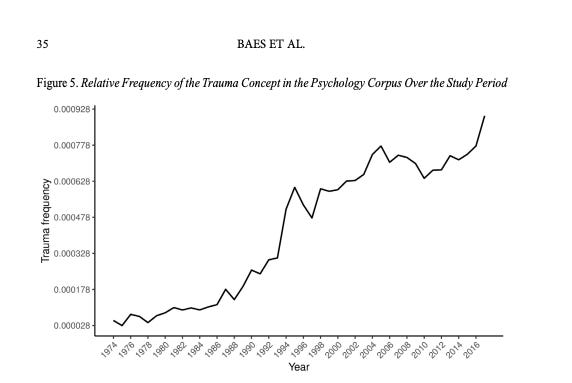
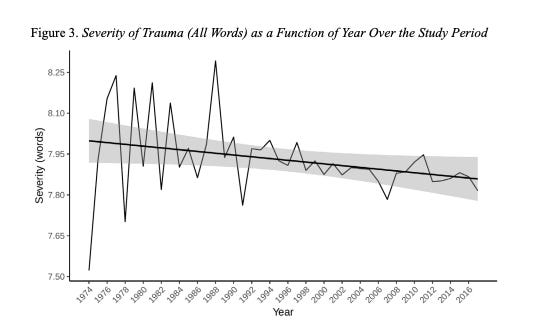
Trauma, depression, anxiety—these can be important lenses through which to see your life. But if more and more things are them, then less and less in your life is something else. If every problem can be explained away by trauma or clinical depression or anxiety or borderline personality disorder or bipolar disorder or narcissistic boyfriends or being HSP or whatever, then you have in effect chosen to stop seeing the world through any other lens, and thus you have given up larger and larger amounts of your own agency, sloughing off layer of layer with each attempt at externalized reasoning or internalized diagnosis (“sorry I struggle to call you back because of my ADHD,”; “I can’t be in a good relationship right now because I have insecure attachment issues stemming from parentification.”)
People do this—attempt to define, pathologize, categorize—because it gives them power. But power is not the same as agency. Power is something you wield over others. Foucault wrote of how institutions used categorization and diagnosis to maintain control over their populations. It makes sense now in the age of neoliberalism—in which all of our lives are as fractured as the institutions that once yielded (more) power over us (governments and their systems of economics and health care and punishment)—that we would instead now do this to each other and ourselves. Uberification but for emotions.
The ability of the government to control us via definition has been weakened, but the desire for control has not gone away. And so into that power vacuum all of us step, picking up the weapons left by those who formerly defined us and restarting the battle ourselves. En garde, narcissist! Touché, highly sensitive person!
And we do this because it makes us feel safe. To define someone (oneself or others) is to attempt to ensure that others do not affect you; it is to attempt to ensure you are not surprised; it is to attempt to ensure that you are not hurt. It is understandable in an era as dysregulated as ours. An attempt to control a world out of control. But all it does is leave you more and more alone, more distant and afraid of your fellow man than ever.
Agency is not about pulling on your bootstraps, it is about putting down those weapons. It is about realizing that once you stop attempting to categorize and define and pathologize yourself and others into positions of submission, you will be left standing there in the arena with nothing but yourself and others, and an infinite number of things to do together; things more beautiful and weird and wild and fun than the safety of domination and desolation through definition. Maybe you’ll go get into a messy relationship that hurts you but also changes you. Maybe you’ll decide that feeling overwhelmed and crying a bunch is a worthy price to pay for connection to community. Or maybe you’ll look around the arena, and be stronger than Carmela, and decide the first step towards the rest of your life is to just leave. The beautiful thing and the terrifying thing is that that’s up to you.
Yes! And for someone who has lived their whole life confused as to why they struggle so much, a diagnosis can provide a lot of relief, even if that relief is only a starting point. Of course, the ideal version of getting a diagnosis or identifying with a disorder like ADHD is that it gives you tools to actually improve your life via medication or new coping strategies, not to provide an all purpose excuse for anything bad you do. This is why I do think that diagnoses, as flawed as they are, can still be useful (that and insurance rebates). I'm also wary of going too far in the other direction towards the RFK Jr. banning SSRIs or the "mental illness is all fake" camp. But that's the constant grey area we have to live in, as you say!
The Carmela anecdote reminds me of a line I just heard during my 37th Mad Men rewatch: Don and Betty's neighbor Helen, a divorcee everyone judges for being a divorcee, tells Betty that the hardest part about divorce is "realizing you're in charge."