

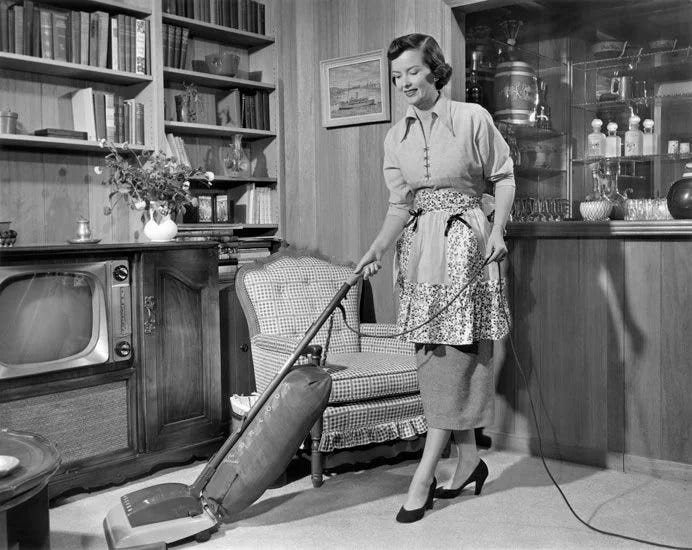
Recently, the White House proposed raiding federal funds set aside for people living in poverty to create $9,000-per-child bonuses for couples in which one person stays home to take care of the kids. Like everything done by this current White House, it wasn’t only a stupid and evil proposal, but one based in a very specific form of stupidity and evil.
The Tradwife Bonuses are from a long line of Trump-era policy and propaganda that encourage people to understand America’s past as an internetified version of something that never really existed in the first place, something they claim is old and natural and prelapsarian—before we became the complicated and diverse country we are now.
The tradwife is one of the best tools through which to propagandize about this supposedly-better America, because the image it’s based on—the housewife—is ubiquitous and feels like an achievable ideal, one harks back to an age-old Americanism, one more stable and prosperous than what we have now.
Which is funny, because the housewife is only a generation old. Or at least the specific image of housewifery that tradwives and their boosters base their image of tradwifery on is.
Upon further inspection, the tradwife ideal, like much right-wing bullshit, makes no sense.
Basing your life on the image of a 1950s-esque housewife with apron on and bread in the oven and children running around while her husband is off at work makes as much sense as basing your white supremacy on the inclusion of Italians and the Irish. Seventy years ago you would’ve undoubtedly stormed out of your anti-integration meetups had Giuseppe shown his face.
Women, of course, have been oppressed and encouraged to stay confined to the home for millennia, but the housewife as she is popularly imagined is a modern invention. Or, really, not an invention at all but a symptom; a by-product of the real invention I want to talk about, which was material and industrial in scale and policy-based.
The 1950s housewife could not exist without the suburbs, and the suburbs could not exist without post-war housing and infrastructure policy.
Betty Sue or Sandra Dee or whoever only needed a Valium and a gin and tonic and maybe a lobotomy because a few years prior a few powerful men had decided to move everyone like her out of cities to the middle of nowhere, give them nothing to escape with, and propagandize them into thinking theirs was the ideal, or only-extant, life.
Which is to say: much of culture, much of the way we think (or don’t think), is far, far downstream from the structure of the worlds created by the powerful. And certain worlds are structured specifically to help us not think, or at least not think in a way that might endanger the status quo. And we are constantly encouraged to join these kinds of worlds.
In post-War America, the idea of the suburbs was essentially invented by the federal government and influential home building corporations from whole cloth. Most Americans at that point lived in urban areas much closer to where they worked. It took convincing to get people to move farther away to more isolated environs.
Hollywood movies like Mr. Blandings Builds His Dream Home—in which Cary Grant plays an ad executive who is sick of New York City and moves to the suburbs—were partially financed by GE and other home furnishing companies. Magazines advertised buying a suburban home as a patriotic duty once men returned from war. Herbert Hoover’s famous line “a chicken in every pot and a car in every garage” is often remembered as a promise, but it was more of a strong suggestion. The suburbs were the new American dream, and you better go follow it.
Of course, most of the goading was financial: The federal government financed one-third of all private housing in the 1950s; it built a massive highway system to funnel people out of the cities and to these new neighborhoods; it worked with banks to give people historically cheap mortgages.
And much of this maneuvering was explicitly political in its intent: William J. Levitt, of the eponymous, quintessential Long Island suburb Levittown, said in 1948 that, “no man who owns his house and lot can become a communist. He has too much to do.” Before Joseph McCarthy became infamous for his anti-communist witch-hunts in Hollywood, he was busy making the case that multifamily housing and public housing were “breeding grounds for communists,” and advocating for them to be destroyed.
As I wrote in my first book How to Kill a City:
“The 1940s were precarious times for ideological conservatives in the United States. While World War II had solved the economic problems of the Great Depression, culture and politics were in upheaval. Women were working more than ever and becoming increasingly independent of men both politically and economically. There was a brewing gay movement in many major cities, particularly San Francisco and New York. Union membership was high. The United States seemed to be heading toward liberalism. The suburbs became a way to reestablish conservative values. The suburbanization of the United States pushed whites into a privatized, anti-communal form of living, encouraged more traditional gender roles (women as housewives, men as breadwinners), and reified racial boundaries—keeping white people separate from black people, Latinos, and other ethnic groups.”
In other words: the image we have of the housewife in the 1950s only exists because the ultra-powerful wanted it to. Secure inside her detached abode, fed a constant stream of idealized imagery of her own life through her new television, America’s elite could rest assured that white women wouldn’t get any funny ideas from their neighbors or coworkers about silly things like liberation. Because there were no neighbors or coworkers.
It took billions of dollars and several years to achieve this revanchist fantasy—subsidizing cheap mortgages, building expensive highways, instituting racist housing policy. And her existence (and the existence of her goody two shoes husband who dutifully went to work and did not complain to anyone but his wife) was a political success: pushing white people out to the suburbs, tying them to mortgages, dismantling communities (largely communities of color within cities), making it hard for people to physically congregate because they were separated by miles of concrete and asphalt, all made the US a more conservative, less intellectual country; one that was less open to rebellion.
At least for a time.
The suburbs are no longer nearly all-white. And they are more politically diverse than they ever have been. And yet the need has persisted for the ultra-powerful to keep us docile and separate distracted enough to not inflict damage upon their system.
And so: you can and should view the lobotomized culture of today, your own fealty to it, and your resultant distractedness and stupidity, as the result of a successful infrastructure project carried out by the wealthy. This may just feel like the water in which you swim, but the lake is man-made, and you were trucked in, little fish.
The powers that be have suburbanized your mind. They’ve turned your psyche from a place that once was much more like a city—filled with frictive potential, contact between disparate ideas and modalities of seeing the world, diversity, and the possibility of political activation—into a sterile box built on a plain far away from anything else where danger(ous ideas) might lurk; a box that feels amenable to live within only because of the even smaller box inside it, the entertainment apparatus that delivers you little shocks of dopamine so that your psyche does not totally vegetate into nothingness and remains convinced it is still alive even if in most senses it is not. Were this entertainment apparatus in your psychic McMansion to suddenly disappear, perhaps you would realize you are trapped in the middle of nowhere with nothing to do and few people to talk to.
The powerful no longer need to build billions of dollars of highways and subsidize billions of dollars of housing to achieve this goal of psychic devitalization. But make no mistake that there is an equally if not more powerful infrastructure project being conducted with the express goal of creating country-wide complacence.
The internet, after all, was created by the same powers that built the suburbs: the federal government took a military tool known as ARPANET and then in the 1990s handed it over to corporations to do the rest of the work for them. Social media remains largely unregulated because the same people who want your psyche to remain dormant are some of the largest donors to our politicians who control the creation and proliferation of our infrastructure.
This only sounds conspiratorial if you think of this process as the result of a few men in a backroom somewhere scheming. But it is just the logic of capitalism: privatized infrastructure helps private interests. And private interests can only continue if we allow them to. And we will only allow them to if we are sufficiently distracted or stupefied or convinced that those interests are also our own interests.
But the people who own that infrastructure are, indeed, a few men. And they don’t even have to hide in backrooms anymore; they can now proudly parade on an inauguration stage and flaunt their influence over our own minds. They are the ones who control our algorithms and the flow of information to our eyeballs. And of course they would decide that a mind less capable of encountering or producing information that would be bad for their own interests would be ideal.
You may be queer or a city-dweller or a leftist or whatever, but I think you are more like a housewife than you know. There you sit, incapable of friction, incapable of leaving the little safe box that has been created for you, and addicted to the ameliorants within it. (What is the equivalent of a housewife’s Valium prescription and her daily dose of her favorite soap operas today? That would be a fun question for you to ask yourself).
All of which is to say that Marshall McLuhan, the media scholar who in the 1960s wrote that “the medium is the message,” was right. McLuhan’s point was that the content of what we ingest matters less than the form. The television itself, more than anything on it, created an image-based culture in which people were convinced to listen to and follow whoever and whatever the box told them was best (you can’t keep up with the Jonses if the Joneses don’t know to buy a GE washing machine in the first place).
And the same could be said of the internet. It is less about what we see on it, and more about how it restructures and restricts our own psyches, de-skilling us so that we cannot think critically or write critically, preventing us from finding adequate socialization, and ensuring our thinking relies more and more on the information generated by a handful of corporations.
“The content or message of any particular medium has about as much importance as the stenciling on the casing of an atomic bomb,” McLuhan argued. “The effects of technology do not occur at the level of opinion or concepts, but alter sense ratios or patterns of perception steadily and without any resistance.”
As the great thinker on technology L.M. Sacasas wrote recently, AI is simply the latest and most realized version of this mind-bending infrastructure. It is not a tool, but, “an environment which envelops the user and works on us from the inside out while we naively think that we remain unchanged by our use so long as we are using it carefully and intentionally.”
Crucially, McLuhan wrote that most of us have not clue this is even happening as it happens. The infrastructure becomes totalizing until it feels like it has not only no escape, but that there is nothing to escape to. “We don’t know who discovered water, but we’re pretty sure it wasn’t a fish” McLuhan was fond of saying. And so too you in your man-made pond swim, unaware it is man-made, or that it is a pond.

Today, those born and raised in the suburbs may think of them as quintessentially American things, but also somehow natural and perennial and just there. They may feel lonely and disengaged but not really know why.
Today, those born and raised on the internet may not know that being here was a choice, not made primarily by us, but by those who wished to make us isolated and disengaged and stupid, and left not knowing why, or that there may be an alternative.
A few days ago I made the once-every-few-months mistake of opening “X.” I was immediately inundated with people yelling at each other about any and everything. It was not (only) the content of what they were saying that was stupid, but the fact of them thinking it was necessary to say at all. (I think they were talking about something at a socialism conference and Ozempic. Does it matter? Will it matter in a few weeks? Or do you just want the dopamine hit of participating?).
My brief foray back onto the platform was a reminder that we all have been goaded over the years into thinking in small soundbites that don’t really serve the purpose of convincing another of one’s cause (do you really think your posts will change someone’s mind?), but of profiting one evil billionaire, and, more importantly, of restructuring our psyches so that they become amenable to that billionaire’s desires. A populace that thinks in soundbites cannot form rational political thought nor convince anyone of that thought. It does not matter if the internet users are saying things that are “right” or “wrong.“ The posts only exist because they are both profitable for, and nonthreatening or actively beneficial to, the infrastructural order that brought these prognosticators to the platform in the first place.
Screaming into your box in the middle of a barren plain, convinced this is something other than what it is, which is nothing.
Thankfully, these purpose-built, infrastructural worlds always have a way of cracking.
Eventually, someone looks around their empty box and goes, “wait a minute, isn’t there more to life than this?”
The recent death of Gloria Steinem made me remember that the past isn’t that far past, and that capitalist-created, lobotomy-causing infrastructure, while often totalizing, is always temporary. It was only one generation ago that white, suburban women were expected to stay in their little boxes and do the dishes and take care of their kids. Until a few women, and then many, said, “enough of this.”
Capitalists created the suburbs to keep people docile, but in doing so also bred a movement against not only it, but them. Now they’ve created the internet. Who will be the first Friedan or Steinem of the internet age to stand up and say “enough”?
A fascinating and excellent read. Something that lingered in my mind as I read this was the history of cities and the role of true rural communities. Didn't the industrial revolution promote the expansion of cities (partly) as a way to exploit the worker? The negative impacts of cities (particularly on the psyche) and the industrial revolution is an important research topic to me so I would be interested in understanding what potential psychological value the suburbs (and rural communities) hold. Obviously a major sacrifice made is a diverse community, but I would argue that living in a city doesn't necessarily mean you participate in a more diverse community than if you lived in a suburb. It all depends on the area and the participant themselves. Part of the appeal of suburbs was/is that "there's more room to breathe/it's a better place to raise children/sense of refuge away from work" etc. which of course all contributes to division and many things mentioned in your essay, but two things can be true. I suppose it all goes back to our desire to escape from exploitation and gain independence which is impossible regardless where you turn. There is always a sacrifice, and there is always government/a company to take your life from you wherever you are. Even if I go "off the grid" I lose community (a cult does not count of course) and Google Earth will still find me. I suppose I am rambling, and I suppose I should just be asking "What do I want my prison to look like?"
The defining characteristic of the American mind is the insanely high tolerance for hypocrisy that our culture breeds into us since birth. The suburbs are a physical manifestation of the walls we build within ourselves to keep ourselves from going insane from holding too many contradictory beliefs at the same time.