

This is part 1 of 2. Next week will be about the history and psychology behind these pyramid schemes. That one will be paywalled, just FYI. This one is not.
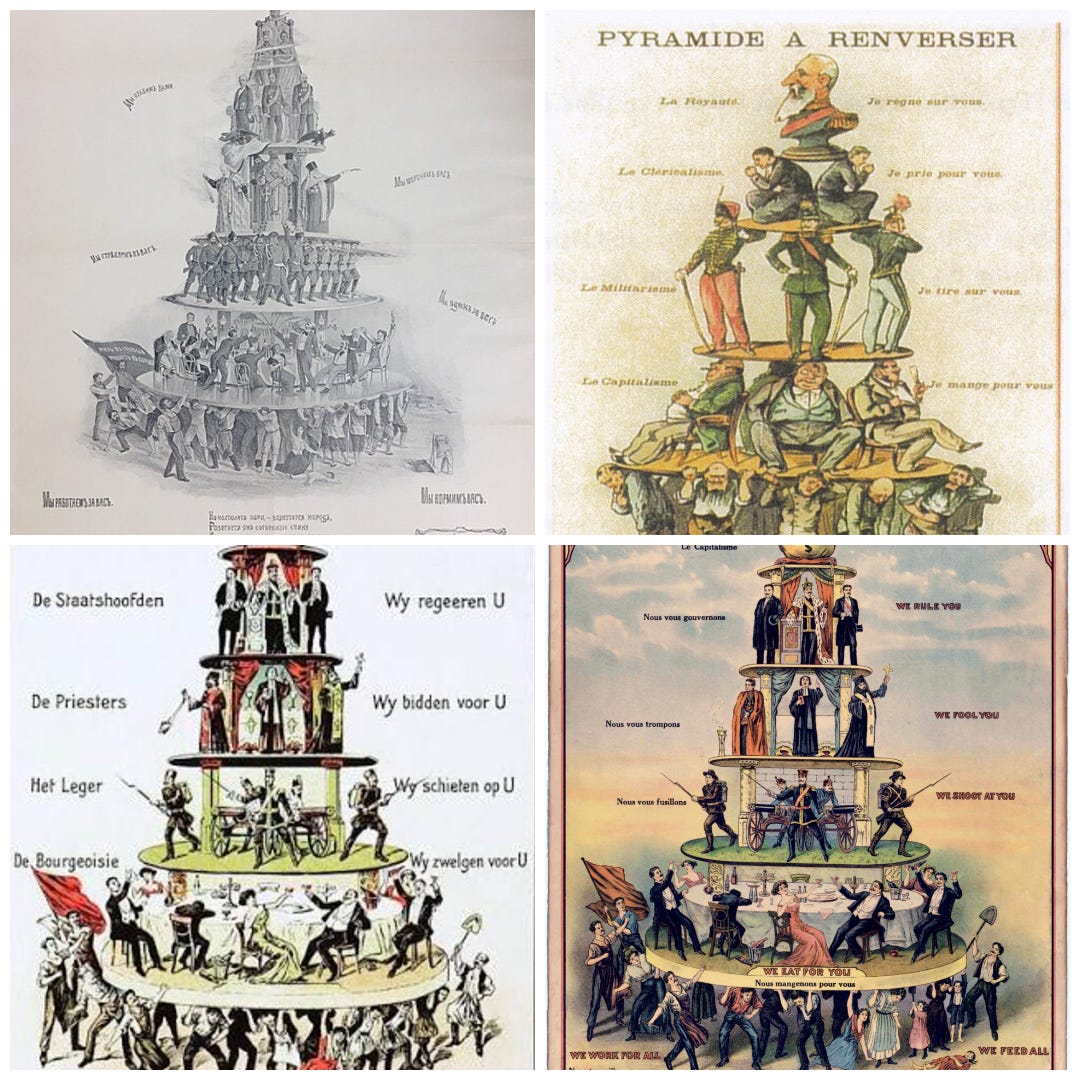
Imagine, if you will, a segmented pyramid. Kinda like the FDA food pyramid. At the bottom of this pyramid is the working class—oppressed, struggling to make ends meet. There’s a lot of them. The base of the pyramid is, like any pyramid, bigger at the bottom than at the top. Then in the middle you have, you guessed it, the middle class. Smaller in number but higher up. And so on and so forth until you reach the top, at which sits the smallest yet most powerful class—a group of people who are mostly men, mostly white, mostly cis, mostly heterosexual, and all very, very, very, very rich.
This is the reality of the United States and nearly the entire rest of the world today. It has been for generations. To say it is reality is not an opinion but fact. There are a vanishingly small number of people at the top who control much of our wealth and thus much of our political system, and exponentially more of us in the middle (which really is nowhere near the top but much closer to the bottom) and exponentially more still in the bottom (the latest stats are that the 1 percent 31.7 percent of wealth in the United States, while the bottom 50 percent control 2.5 percent).
This pyramid is how many people have thought of the capitalist class system for decades across the entire capitalist world: The images at the top of this essay are from an American communist poster from 1911, the 1901 Russian poster it was inspired by, and two similarly-dated European versions.
That’s where our shared understanding ends.
It is when we get into what to do about this evil pyramid that things become really complicated and messy, as they are bound to be when people attempt to think through how to change or overthrow or outgrow a deeply-ingrained (in the world’s economies and cultures, and in people’s psyches) system of governance and control and production.
Unfortunately, in our desperation for a solution to this pyramid that grows ever-heavier on our aching backs, a large chunk of the left-leaning world has fallen for a false solution to the problem of the capitalist class system.
This proposed solution—like any pyramid scheme—does not benefit those who partake in it unless they reach its highest levels of control. And the solution—like every pyramid scheme—attracts people to it through its deceptive simpleness and easy-to-envision (false) promise. And—like with every pyramid scheme—the people who stand to benefit from it get very defensive when you threaten its operation, or even simply suggest it might have some flaws.
The anti-capitalist pyramid scheme pitch goes something like this: what if we just inverted the capitalist pyramid? What if we just put everyone at the bottom at the top?
***
A week ago, a Boston Globe story about a small lesbian bar in a small town in Western Massachusetts went mega-viral because 1) it was a good slice-of-life story about a very particular and peculiar community and 2) because, despite being an extreme example of “leftist” behavior gone awry, it resonated with countless people across the left-progressive-Democrat political spectrum.
On the internet and in my real life I have heard varying versions of this same story: people with good intentions attempt to build something, and then it is besieged by infighting in which everyone is trying to one-up each other via leveraging whatever oppressions they may genuinely or not-genuinely or partially-genuinely face as forms of emotional and thus organizational currency.
In this case, the specifics are, briefly, as follows: the bar, which opened only a year ago, had enforced a mandatory masking policy in an attempt to make immunocompromised people feel more welcome. It then attempted to end that policy. Accusations of unpaid emotional labor, white violence, white saviorism, anti-trans sentiment, policing, and, of course, eugenics, began being leveled. A professional therapist was called in to help mediate and then she dismissed. And then the entire thing collapsed.
While the story was seen as humorous by many (and, to be clear, in some ways it was), I was struck by the real harm buried within it and hardly mentioned in all the discourse: a community space for queer people was ruined, and real people were harmed: Jackie Matellian, one of the owners of the bar ended up homeless and living in her truck for six months, and tens of thousands of dollars in debt in an attempt to appease everyone and keep the bar open under its strict yet ever-shifting rules of “inclusion” (rules that actually drove everyone away from the space). Her incessant appeasement did not work. Revealing to her cohort that she was in debt resulted in accusations of “centering her feelings” above others.
The spiral is still ongoing: “There’s conflict,” Matellian said. “That’s the price you pay to be in community.”
Is it? Or is it the price you pay to be the victim of a pyramid scheme?
Unfortunately, I have heard many stories like this throughout the years from union organizers who cannot get anything done without people in their own coalition attempting to stop them because of a minor disagreement; from committed radicals who became apathetic after years of feeling like every single comrade was at each other’s throats; from people sticking their toes into the scene who immediately get scared off by this behavior.
One of the people I used to organize with in Philadelphia—one of the many of who burned out of the scene years ago largely because of similar infighting— is a nurse who works with mentally ill people, a communist, and one of the most dedicated activists I’d ever met. She told me last week that she can no longer participate in organizing largely because she was routinely made to feel “embarrassed and ashamed” at every turn when she even lightly disagreed with some of her fellow organizers.
“When you care about people and see that they are hurting—and they really are hurting even though it makes no sense—you want to help them,” she said. But then no matter what you do, if you, “set a hard line [against their behavior], they will go on a harassment campaign.”
“One thing that I have learned if I ever join a leftie group again is that the most important thing is for everyone to be completely united and on the same page against this behavior,” she told me. “Because if even one person falls for it, it causes chaos. And the other thing is to not believe a single thing these people say.”
The systemic conundrum as to why this always happens is obvious to her: “The problem is: it’s hard to change your behavior when you’re benefitting from it.”
And that’s the key point here: someone is benefitting.
**
The pyramid scheme operates as follows: people of a similar, lefty political persuasion gather together to do good deeds. Within this space there is at first no clear social currency because everyone is theoretically gathered there to do things that go against our current system of both literal and social/political currency (i.e. capitalism).
And then, relatively quickly, within this void, people begin to invent a currency of their own. And because these people stand morally opposed to the class pyramid we’ve all grown to know and hate, that pyramid gets flipped on its head: those who can claim to be at the most bottom sliver of the extant capitalist pyramid—i.e those who have the most oppression—get valued the most in this theoretical new pyramid. Their insight gets prioritized. Their “needs” get validated, no matter how ridiculous they may be. And those who have more of things valued within the capitalist pyramid (money, social standing, rational thinking skills) are meant to be placed at the bottom. Their thoughts matter less. They are not to be given power.
This creates a psychic arms race: People excavate whatever they can from their pasts, their identities, their traumas in order to build a version of themselves that had more currency in this upside-down pyramid. That’s when you start to hear “as someone who,” and “when I was a…” and other such phrases. People are attempting to print their currency.
Whoever can most effectively exploit their own minds and pasts and communities begins to rise to the top. And this in turn creates illogical allegiances within organizations; alliances that cannot really get anything done because they are set up not for outward change but for internal power. People cling to whoever promises to bring them the most social currency within the organization, which is whoever can most successfully weaponize their oppression (legitimate or exaggerated or fabricated). And thus people start to act not out of comradely love for each other but out of fear of being left behind as others around them ascend up the pyramid; or out of fear that they will be kicked down a step in the pyramid for not showing sufficient fealty to those rising to the top.
This currency system ends up privileging those who are willing to lie or exaggerate or act hyper-individualistically in order to climb their way to the top. And so you get organizations run by narcissists and sociopaths and scammers. It is, in that way, again, like every other pyramid scheme.
And, of course, like every other pyramid scheme, it benefits very few, and can ruin the lives of nearly everyone else within it. People’s emotional and temporal and often financial investment gets wasted in their chasing of the false promises of those at the top of the pyramid—that they will soon be granted Good Personhood if only they keep on investing and convince others to do the same. They feel depleted. They surrender. The people at the top use this energy to continue their rise.
But, like many pyramid schemes (and unlike real pyramids), the structure is inherently unstable. The people at the top get too greedy, the people at the bottom have nothing left to give. And so eventually it often all falls apart. People get burned out, or banished, or just feel like it’s not worth it anymore, and leave poorer (emotionally, but also sometimes financially too) than they came in.
And all the while of course, the capitalist world stays unchanged. But we become more ruined within it; oppressed not only by the capitalist class above us, but by the petty tyrants atop the ten thousand tiny pyramids in our wide yet crowded slice of the bottom who’ve worked to divvy up the little space we have in order to create their own micro-fiefdoms.
It’s sad. It hurts. It ruins.
In a way, I was happy to see the the Western Massachusetts lesbian bar story go viral, because I think it shows that people are waking up. There are countless good people out there, and nearly all of them have had an experience within one of these social justice pyramid schemes.
As of now, I think many of us are sitting outside these pyramids, waiting for something to change. My friend in Philly is. I have many other friends who are in similar positions—wanting to participate again, but feeling scared. I’m scared too. I’m sure many of you are too. Again, the consequences are real, not only emotionally, but often socially and financially. People end up feeling completely outcast, alienated, and on top of that guilty for their own victimhood because they are good people, assuming it must be because they did something wrong, that it must just be “the price you pay to be in community.”
But, of course, we are all needed, now more than ever. We all should be getting off the sidelines and into the game. Unfortunately, people who stand to gain from their harmful behavior usually don’t stop harming people willingly. As the recent kerfuffle in Western Mass proved, these people aren’t going anywhere if we allow them to keep scamming. Perhaps it is time for you good people out there to storm the pyramid, and forcibly turn it into a better shape.
NEXT WEEK: The origins of the social justice pyramid scheme and the psychology behind it.
Thank you. This caused me to feel strong emotions.
It's almost a comic tragedy that so many of us, who claim abolitionist values, replicate Puritan punishments.
This reminded me of Jo Freeman's The Tyranny of Structureless