

The American Dream has, of course, always been a lie. But it at one point served a purpose. With enough work, the indoctrination taught us, any of us could make it—get married, buy a house, save money, retire.
Perhaps more people these days are realizing that this dream is a fantasy. Perhaps more people have seen it for what it is—a way to encourage us all to keep our heads down and not challenge the system, in hopes that some day our exploitation would lead us to greener pastures.
But even for those of us who never believed in this dream, we, for much of recent history, had alternative dreams—ways of envisioning the future that provided us hope.
The progressive version of the American Dream was a collectivist riff on its central premise—that with enough work, things would get better. In place of individual capital accumulation were things like racial and gender and economic equality. Collectivist movements were built around the idea that, as Martin Luther King Jr. famously said, “The arc of the moral universe is long, but it bends toward justice.”
There seemed to be an inflection point between these two dreams in 2020. The Covid lockdowns made chasing individualist American Dream seem more preposterous than ever.
First by showing us how tenuous those materialist things we’d supposedly been working toward had always been: If the world, our lives, our health, were not guaranteed, then what, exactly, were we hustling for? If a virus could shatter the world’s supply chains within a matter of weeks to the point that the ability to buy toilet paper was no longer a given, then how stable was the future we looked toward anyway?
And then by showing us that there was another kind of dream available to us, one that was more collective and exciting. Protests over racism and police violence exploded onto America’s streets partially because people were angry over these things, but also, I believe, because the other American dream, the one in which we worked for our own white picket futures, no longer made sense. A space had been opened for something else.
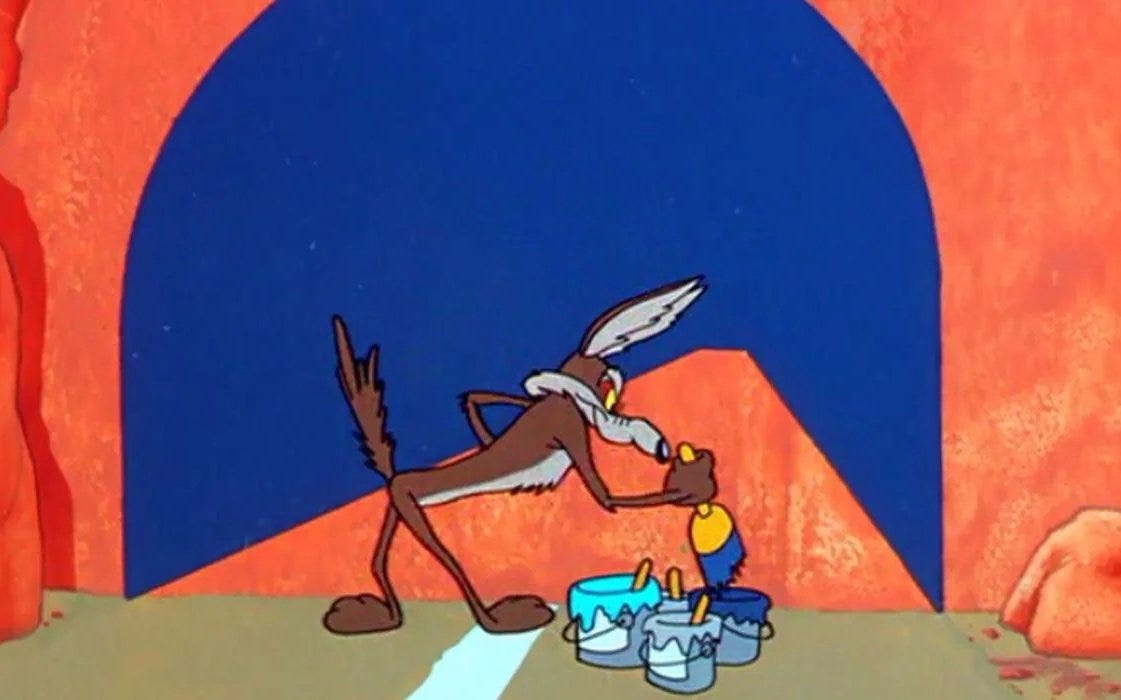
The original American Dream reminds me of Wile E. Coyote painting a tunnel onto the side of a mountain, only to trick himself into running into it. Somewhere in us, we know that the premise of chasing individualist success for diminishing returns is silly, but we keep running anyway, certain that if someone—that damn Road Runner, for example—can run through the mountain and get to the other side, then we can too. And then, of course, smack.