


Hello!
How is everyone today? The world, as usual, seems bad. And it is perhaps our duty to figure out why, or at least to figure out how to survive its badness. But often when we attempt to do this, we’re starting too far ahead. We debate ideas about capitalism and politics and gender and all the rest, and it goes nowhere. We yell at each other on the internet, we protest, we organize, and the world keeps getting worse.
I think this is because none of us are on the same page. A lot of us aren’t even in the same book! There’s no hope of convincing people of your cause if they exist in a completely different reality. We’re not only separated by an infinite number of distinct, algorithmically-generated personal universes, we exist with highly variable abilities to see through those realities, to think about them critically.
If we want to have any hope of bettering the world, we first have to make sure people live in the same world. And a large part of the solution to this problem is to make sure people have the ability to understand the realities they live in. In short, we have to make people less stupid.
Fifty-four percent of Americans can’t read above a 6th grade level. How do you convince those people that your side is right? How do you convince them that they deserve a better world if they cannot understand the world they live in, or their place in it?
That was the theme of a talk I gave a few weeks ago when I was invited by the French Embassy to speak at their cultural center, Villa Albertine. The theme of the night was Enlightenment—how do we carry forward ideas of democracy, creative expression, and freedom of speech in our current era? And my answer was: we can’t even begin to debate these things until we ensure the people around us are capable of understanding reality. You can watch the talk here.
And that’s also the theme of today’s Link Drop: if we want to make the world better, we have to start at Square One—strengthening our bonds to our fellow humans so that we live in the same reality, and ensuring they have the same resources and ability to understand that reality.
-I’ve been reading a lot about the fascinating and depressing history of a group of 200 chimpanzees in Uganda who for decades coexisted in peace, and then suddenly began a civil war. The chimps originally lived in three separate but overlapping bands. When each of the bands would encounter each other, they’d hang out—grooming each other, socializing, sometimes finding new mates. But then the killings began. So far, 24 chimps have been killed, including 17 infants. The chimps have become on-guard in their respective territories, showing nervousness if they even hear the sound of other chimps in the distance. Though the exact reason for the start of their war is unknown, scientists believe the war’s continuation and exacerbation is because the groups stopped communicating with each other. After a small conflict between a few chimps from different bands about a decade ago, and after the death of one particular chimp who was responsible for inter-group communication (he died during a respiratory epidemic), the bands stopped trusting each other, and started self-isolating in their own bubbles. The researchers suggested that the chimp civil war could shine light on human violence. Perhaps, they argue, religion, ethnicity and politics play less of a role in our constant conflict; perhaps the progenitor of our own wars is simply communication breakdowns. Living in separate bubbles not only makes our worlds smaller, it makes us fear anyone outside those bubbles. The Trump Administration, of course, has proposed cutting the funding to this group of researchers.
-If it is indeed true that separation from each other’s realities allows for constant violence, that could explain a lot of what we’re going through today in the U.S. The Cut has a story about “The Great Numbing Out”—looking into why people are so much less willing to protest and resist Trump this time around, as compared to the constant actions against his administration in 2016. The thesis of the piece is that we’re all overwhelmed, that our nervous systems have been strained so that we’re constantly in fight-or-flight and are constantly just trying to keep our heads down to survive. And while this is likely true, I again think there is a more base-level problem that leads to those things: disconnection from each other encourages us to feel overwhelmed and scared. Without community, we are left to deal with all this bullshit on our own, and our individual nervous systems cannot handle that. Perhaps the biggest difference between 2016 and 2026 isn’t the amount of overwhelm caused by our politics (though that too), but the fact that we are now much more isolated from each other, and thus unable to effectively communicate that overwhelm and weather the storm together. Let’s not forget that there was a pandemic in-between the first and second Trump terms that radically altered how people interacted with each other.
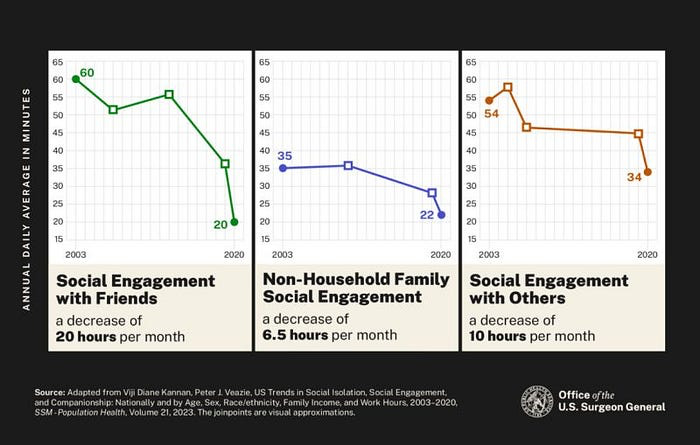
-But the numbing out we’re experiencing today isn’t unique. A new book by Ian Burma—Stay Alive—chronicles the lives of Berliners during the rise of Naziism and finds that they largely did the same thing we’re doing today to survive: they disconnected from the reality around them, either spatially by exiling themselves to other countries, or culturally and politically, by creating existences ever-more isolated from the violence around them. As Kevin Peraino writes in his review of the book: “Dictators, in reality, thrive not on love but on indifference.”
-I don’t think it’s conspiratorial to say that if I were a person with a vested interest in increasing the violence of the world—destroying its environment, sending people into lives of poverty and misery—and an interest in decreasing any form of resistance to my evil machinations, the first step I might take would be to encourage people to live in bubbles from which they cannot, or at least do not want to, escape. In other words: if you wanted to start a civil war, your first step might not be an act of violence, but of disconnection.
Perhaps that’s how we should view modern technology—as a tool of communal severance, encouraging us to be in our own warring factions. The internet, after all, was largely invented by the U.S. Department of War (née Defense).