

This is part three of a series on fostering your own agency. You can read part one here, and part two here. Go forth and prosper or whatever!!!!
A few years ago, a friend who likes to have fun and be gay went on a trip to Maine with some highly-educated 30-something straight people. They played Scrabble. They cooked locally-sourced food. They talked about possible future pregnancies. They had one or two glasses of natural wine in the evenings and then went to bed around 10pm.
My friend came back from the trip deeply depressed.
We landed on a term for this experience: Maine Death Syndrome—ennui, or something even deeper than it, stemming from the sensed expiration of one’s future; a knowledge that while life might continue to exist, it will likely do so ever-more demurely, without spark, without oomph.
After the bravado of your teens and the exciting and confusing life-figuring-outness of your twenties (not always fun but always full of energy), this syndrome, it seems, happens to many people: they stall. They think that all that might await them is death. Not quite a midlife crisis—which could, maybe, in a way, feel better; a crisis is something you have to fix. Stalling out, treading water—that can continue forever.
In my twenties, I frequently heard tell of this kind of thing, tales passed down by my elders of their friends who had become unbelievably boring and normal. Ghost stories.
But I never really worried about them. Because, for a while, it felt as if my friends and I had all escaped this curse.
Queerness offered an alternative vision to a life of empty pleasantries and soul-crushing ennui—go out, party, do drugs, fuck lots of people, get into complicated formations of relationships. This worked swimmingly for about five years, for me at least. Why would I need to answer the bigger questions about life and my purpose in this world if I was having fun, if I felt supported by my friends, if there was always something new on the horizon? The perpendicularity of my life to the straight world felt in and of itself like activism, or at least a personal protest—I was showing how people might live if they removed all the internal walls they’d built up inside them to keep them on the straight and narrow. Life could feel free. Even if its material circumstances were increasingly not.
There would be no Scrabble playing in my future.
And then I hit the wall.
I became rather sick of partying. I became rather desirous of stability. Juggling all the complex relationship formations felt increasingly like a chore, not a privilege. But most of all, it all just stopped working—things, even really fun things, stop being fun when you do them too much and for too long.
To the outside observer, or really to my own conscience, my life appeared vastly different, and perhaps better, than those who “settled down.”
But really what is the difference between two glasses of wine and a 10pm bed time and two lines of ketamine and a 10am one? The next day is still the same. The world around you is still the same. The front page of the New York Times still bleeds red whether it’s read in Bushwick or Brunswick.
I’d confused defense mechanism for solution.
And after the defense mechanism stopped working, I found myself facing the very thing I believed I could skip right past. I wasn’t in Maine, I wasn’t playing Scrabble, but there I sat, bored in my apartment, unsure if this was all life had to offer.
It had been easy to make fun of those people in Maine, but in many ways they were further along in their enlightenment than me—giving into the inevitability of adult life, which is often boring and filled with the quiet restlessness of doubt: is this all there is?
I was now a step behind them in answering that question for myself.
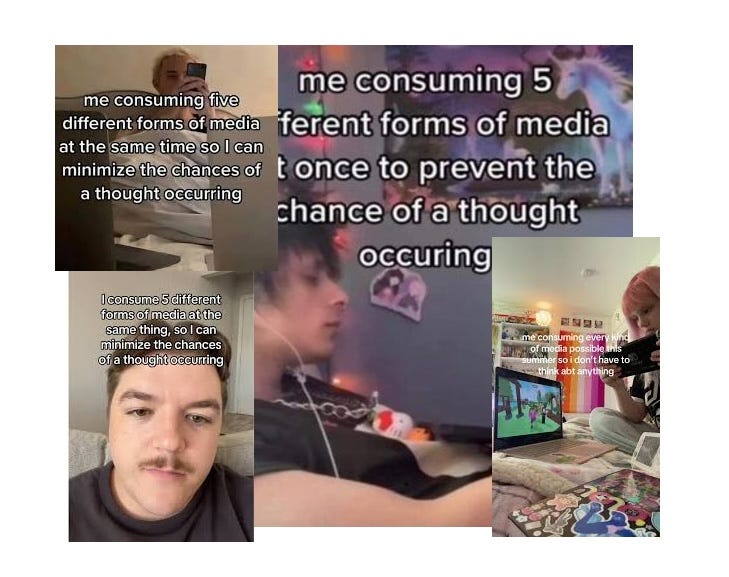
This, I believe, is where many of us find ourselves—in an era of unending defense mechanisms to prevent our own versions of Maine Death Syndrome. A punting of existential dread into our futures.
What is our world these days if not one big distraction from ennui?